
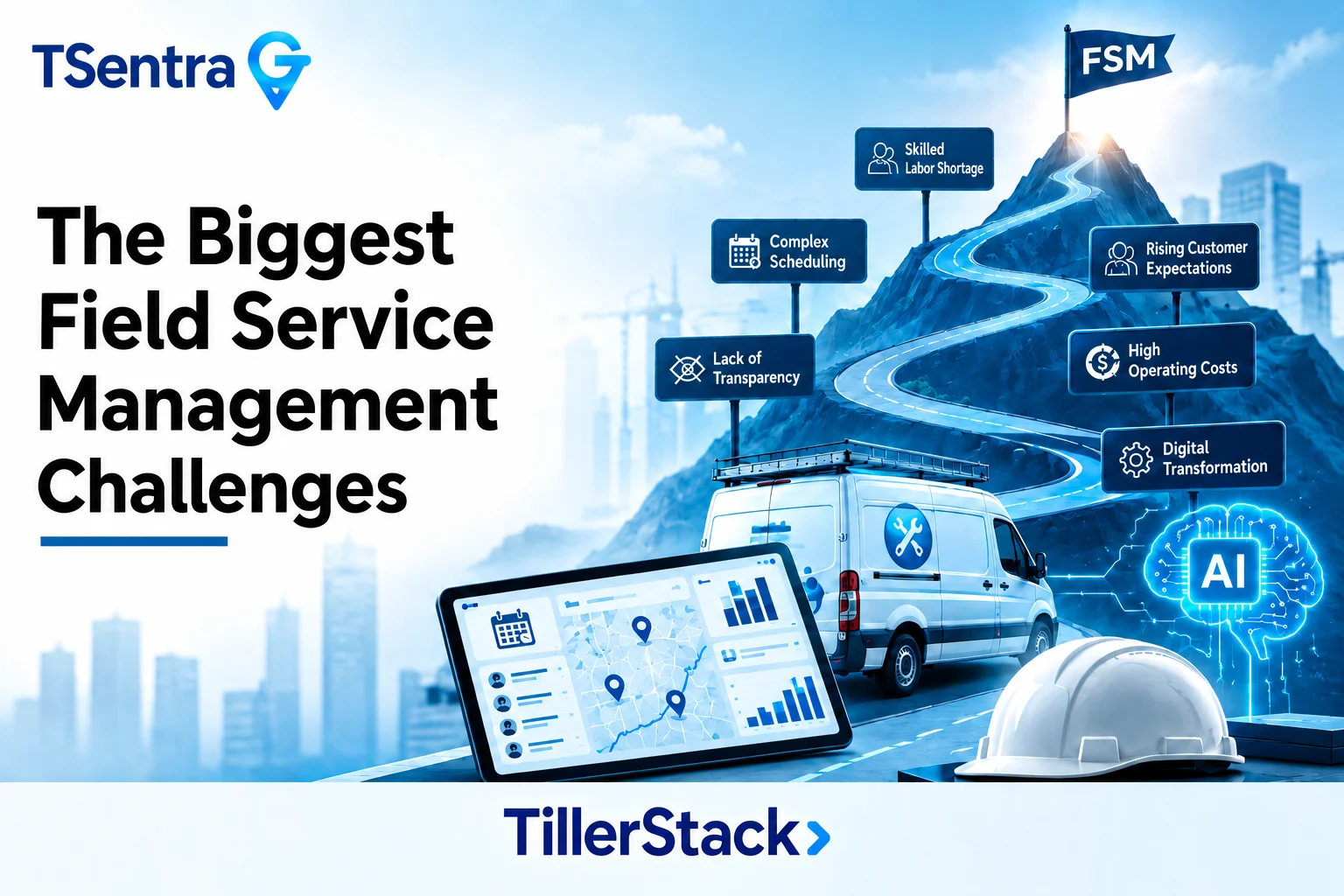
How companies can future-proof their service organizations with AI, automation, and intelligent processes
Field Service Management is undergoing a transformation. While companies have focused primarily on digitizing their field service processes in recent years, intelligent automation, artificial intelligence, and data-driven decisions will take center stage in 2027.
At the same time, the demands placed on service organizations continue to rise. Customers expect shorter response times, transparent communication, and fast problem resolution – ideally on the first visit. Meanwhile, skilled labor shortages, rising operating costs, and complex service processes are making day-to-day operations more difficult for many companies.
For service managers and dispatchers, this means handling more service calls with the same or even fewer resources, without compromising on quality or customer satisfaction.
Modern Field Service Management platforms such as TSentra help companies overcome these challenges. AI-powered scheduling, intelligent dispatching, mobile service processes, and real-time transparency make it possible to automate workflows, deploy resources optimally, and scale service organizations sustainably.
In this article, we present the ten biggest challenges in Field Service Management in 2027 – and show how companies can address them successfully.
Why Field Service Management Is Changing in 2027
The digitalization of field service is no longer a vision for the future – it is a prerequisite for competitive service organizations. While traditional field service solutions primarily supported the planning of service calls, modern platforms now connect all processes on a central data foundation.
The focus is shifting from simply managing assignments to intelligently controlling the entire service organization. Artificial intelligence supports dispatchers with planning, automated workflows reduce administrative effort, and real-time data creates transparency across all ongoing service calls.
At the same time, customer expectations are changing. Customers want to know at any time when a technician will arrive, the current status of their order, and when the work will be completed. Companies that provide this transparency not only increase customer satisfaction but also improve their internal processes.
The 10 Biggest Challenges in Field Service Management in 2027
1. Skilled Labor Shortages and Rising Service Requirements
The shortage of qualified service technicians will remain one of the biggest field service challenges in 2027. At the same time, equipment, machinery, and technical infrastructure are becoming increasingly complex, raising the requirements for expertise and qualifications.
Companies face the challenge of using existing resources more efficiently and enabling new employees to become productive more quickly.
How TSentra Helps
With AI-powered scheduling, service orders are automatically assigned to the most suitable technicians. Digital work instructions, checklists, and mobile information support service technicians directly on site and reduce onboarding effort.
2. Complex Scheduling
Planning service calls is one of the most demanding tasks in Field Service Management. Availability, qualifications, priorities, travel times, spare parts, and service-level agreements must all be taken into account simultaneously.
Manual planning quickly reaches its limits.
How TSentra Helps
TSentra analyzes all relevant parameters in real time and supports dispatchers with AI-powered planning recommendations. This helps optimize routes, reduce unnecessary travel, and shorten response times.
3. Lack of Field Service Transparency
Many companies still do not have a complete overview of their ongoing service calls. Information is stored in different systems or passed on manually.
This leads to delays, misunderstandings, and unnecessary administrative effort.
How TSentra Helps
Real-time dashboards and live status information give service managers continuous visibility into orders, technicians, resources, and service KPIs. Decisions can be made faster and on a more informed basis.
4. Rising Customer Expectations
Today, customers expect far more than a successful repair. They want transparent communication, reliable appointments, and up-to-date information about the status of their service order.
Service quality is increasingly defined by speed, reliability, and customer experience.
How TSentra Helps
Automatic status updates, digital service reports, and mobile communication ensure that customers remain informed at all times and can transparently track service calls.
5. High Documentation Effort
Paper forms and manual post-processing create significant administrative effort and increase the risk of errors. At the same time, requirements for complete documentation and compliance with legal regulations are increasing.
How TSentra Helps
Service technicians document their work directly during the assignment using the mobile app. Checklists, photos, forms, and digital signatures are stored automatically and are immediately available for service reports or invoicing.
6. Disconnected Systems and Lack of Data Integration
In many companies, dispatching, ERP, CRM, warehouse management, and service teams still work with separate systems. This results in duplicate data entry, media disruptions, and high administrative effort.
A lack of integration not only makes collaboration between office and field teams more difficult, but also delays decisions and increases the risk of errors.
How TSentra Helps
TSentra connects all relevant service processes on a central platform and integrates seamlessly with existing ERP, CRM, and third-party systems. Order data, customer information, maintenance histories, and service reports are available to everyone involved in real time – without duplicate data entry.
7. Rising Operating Costs and Pressure to Improve Efficiency
Rising fuel prices, higher personnel costs, and increasing competitive pressure are forcing service organizations to continuously optimize their processes.
Every unnecessary kilometer, every additional visit, and every manual post-processing step directly affects profitability.
How TSentra Helps
Through AI-powered route optimization, intelligent scheduling, and automated workflows, TSentra reduces travel times, unnecessary journeys, and administrative effort. Companies can complete more service calls with existing resources while lowering operating costs.
8. Sustainability Is Becoming a Competitive Factor
Sustainability is also playing an increasingly important role in Field Service Management. Companies are under pressure to reduce emissions, use resources efficiently, and demonstrably achieve their sustainability goals.
Optimized routes, digital processes, and reduced paper consumption offer significant potential, especially in field service.
How TSentra Helps
TSentra helps optimize travel routes, avoid unnecessary service calls, and fully digitize paper-based processes. This not only reduces costs but also supports companies in achieving their sustainability goals.
9. Compliance and Documentation
In many industries – such as energy supply, healthcare, telecommunications, and critical infrastructure – strict legal requirements apply to documentation, traceability, and quality assurance.
Manual processes increase the risk of incomplete documentation and make audits more difficult.
How TSentra Helps
Digital forms, checklists, and automated service reports ensure that all work is fully documented and stored centrally. Companies can meet compliance requirements more easily and create complete traceability for every service call.
10. Scalability of a Growing Service Organization
New locations, additional service technicians, or increasing order volumes create organizational challenges for many companies. Systems designed for small teams quickly reach their limits.
A modern Field Service Management platform must be able to grow with the company.
How TSentra Helps
TSentra has a scalable cloud architecture and can be flexibly adapted to different organization sizes and processes. New teams, locations, or business units can be integrated without complex system changes.
One Platform for the Entire Service Process
The challenges in Field Service Management cannot be solved with individual software solutions. Companies need a platform that intelligently connects planning, dispatching, field service, and reporting.
TSentra digitally maps the entire service process on a central platform – from the initial service request to the analysis of completed assignments.
The Key Benefits at a Glance
With TSentra, companies benefit from:
- AI-powered scheduling and intelligent dispatching
- Higher field service productivity
- Shorter response and travel times
- Digital work orders and service reports
- Less administrative effort
- Real-time transparency across all service calls
- Standardized workflows and higher data quality
- A scalable cloud platform for growing service organizations
- Seamless integration with ERP, CRM, and third-party systems
- Sustainably higher service quality and customer satisfaction
Best Practices for Successful Field Service Management in 2027
Digitalization alone is no longer enough. Successful service organizations rely on intelligent processes, data-driven decisions, and seamless connectivity among everyone involved.
The following best practices help companies future-proof their service organizations.
1. Use AI Strategically as a Support Tool
Artificial intelligence does not replace dispatchers or service technicians – it supports them with recurring decisions. Companies benefit in particular in scheduling, route optimization, and prioritization of service orders.
Recommendation:
Use AI where large volumes of data can be analyzed and routine decisions can be automated.
2. Centralize Data
Distributed information is one of the most common causes of inefficient service processes. A central platform ensures that dispatching, field service, and back office teams always work with the same information.
Recommendation:
Connect ERP, CRM, service, and reporting on a shared data foundation.
3. Establish Mobile Processes
Service technicians need all relevant information directly at the job site. Mobile applications reduce follow-up questions, speed up documentation, and improve data quality.
Recommendation:
Provide work orders, checklists, documents, and service reports digitally on mobile devices.
4. Create Standardized Workflows
Consistent processes improve service quality and make it easier to onboard new employees.
Recommendation:
Use digital checklists, forms, and automated workflows to handle service calls consistently.
5. Make Decisions Based on KPIs
Only companies that know their service KPIs can improve processes in a targeted way.
The most important KPIs include:
- First-Time Fix Rate
- Technician Utilization
- Response Time
- On-Time Performance
- SLA Compliance
- Average Service Call Duration
Real-time dashboards make it possible to continuously monitor and optimize these metrics.
Why Companies Choose TSentra
TSentra was developed to map the entire field service operation on one platform. From the initial service request to the evaluation of completed assignments, the solution helps companies make their service organizations more efficient, transparent, and future-ready.
With TSentra, companies benefit from:
- AI-powered scheduling and intelligent dispatching
- Centralized control of all service calls
- Mobile service app with offline support
- Digital work orders and service reports
- Digital forms and checklists
- Real-time dashboards and KPI analyses
- ERP, CRM, and API integrations
- Cloud-based, scalable platform
- Standardized workflows
- Higher productivity and service quality
Whether companies coordinate ten or several hundred service technicians, TSentra helps them efficiently digitize their service processes and remain competitive over the long term.
Conclusion
In 2027, Field Service Management is evolving from an operational discipline into a strategic success factor. Companies face the challenge of managing rising customer expectations, skilled labor shortages, and economic pressure at the same time.
Companies that want to future-proof their service organizations need more than individual software solutions. They need integrated platforms that intelligently connect planning, dispatching, mobile processes, documentation, and analytics.
With TSentra, companies digitize their entire field service operation on a central platform. AI-powered scheduling, automated workflows, real-time transparency, and seamless integrations create the foundation for more efficient processes, lower operating costs, and sustainably higher service quality.
Companies that invest in modern Field Service Management solutions today gain a decisive competitive advantage for the years ahead.